
Research · Evidence · Impact

Every learner placed accurately,
bridged to advanced opportunity.

Lumino Institute for Education Economics builds the measurement standards and AI tools that study how education turns into economic mobility, and works to fix the places where that connection breaks.

R2AOpen readiness framework
5-partMeasurement model
EquityChecked across every group

The students missed most often are the least visible.

Low-income, first-generation, and multilingual learners whose families cannot navigate the system for them. Our work begins with making them visible.

The problem we started with

Placement systems are static and blunt, and the cost is economic.

A single test, one teacher recommendation, or a past grade decides whether a student enters advanced coursework, and that decision compounds for years. High-potential students fall into a gap: too advanced for regular classes, but rejected by advanced tracks as not yet ready.

The students missed most often are the least visible: low-income, first-generation, and multilingual learners whose families cannot navigate the system for them.

A student walking through library stacks
  • A single placement compounds

    A wrong math placement in 8th or 9th grade can decide whether a student ever reaches calculus, AP courses, a STEM major, or a competitive college.

  • "Almost advanced" gets lost

    Students who need only a few weeks of targeted support get sorted into regular tracks, and never catch up.

  • An under-owned problem

    There is no widely adopted standard for diagnosing readiness, measuring the placement gap, or bridging it. That is an opportunity to build something institutions will use.

What we are building

A research framework, paired with a tool that puts it to work.

The Framework

Readiness to Advancement (R2A)

A method, and an open instrument, for diagnosing a learner's true readiness by competency, measuring the distance to their placement, bridging the gap, and tracking whether corrected placement improves outcomes.

  1. Multidimensional Readiness ProfileReadiness by topic and skill, not by grade level.
  2. Placement Gap MeasureThe distance between demonstrated readiness and current placement.
  3. Bridge ProtocolTargeted 4–6 week modules that close a specific gap, with re-assessment built in.
  4. Mobility Outcome TrackingWhether corrected placement improves access, completion, and longer-term outcomes.
  5. Equity & Visibility LayerSurfaces high-potential learners who are normally missed; checks fairness across groups.
The Tool

PlacementBridge AI

The product that puts R2A to work. A student takes an adaptive diagnostic; the tool identifies exactly where they are ready and where they have gaps, generates a personalized bridge plan, re-assesses, and produces a readiness report for the teacher, advisor, or parent.

Adaptive diagnostic Gap identified Personalized bridge Re-assessment Readiness report
Measurable by default. The diagnostic → bridge → re-assessment loop produces clean before-and-after data automatically, so the evidence of impact builds itself.

How we work

Research and product are one engine.

Measure what matters

Outcomes tied to mobility, not engagement, clicks, or compliance.

Standards over silos

Open methods and instruments others can adopt, so our influence compounds.

Equity by design

We surface learners who are normally missed and check fairness across groups.

Evidence before claims

Every claim earns its place with data. We report honest results, including null ones.

Build, measure, publish

Each project ships as a method, a tool, and evidence, together.

Every project moves through the same pipeline, and the loop repeats.

  1. 01
    Problem

    Find a real, under-owned problem with measurable stakes.

  2. 02
    Framework

    Develop the method and measurement model.

  3. 03
    Instrument

    Turn it into diagnostics, rubrics, and protocols.

  4. 04
    Tool

    Build the product that delivers and logs outcomes.

  5. 05
    Pilot

    Deploy with a partner under consent & ethics; collect data.

  6. 06
    Analysis

    Analyze outcomes and fairness across groups.

  7. 07
    Publish

    Share framework and results openly; release the instrument.

  8. 08
    Adoption

    Track who adopts it, and feed the next cycle.

Active research

An evidence base, built in public.

Our founding research portfolio. Each project pairs public-data evidence with a Lumino framework and a proposed metric.

01

The Placement Gap

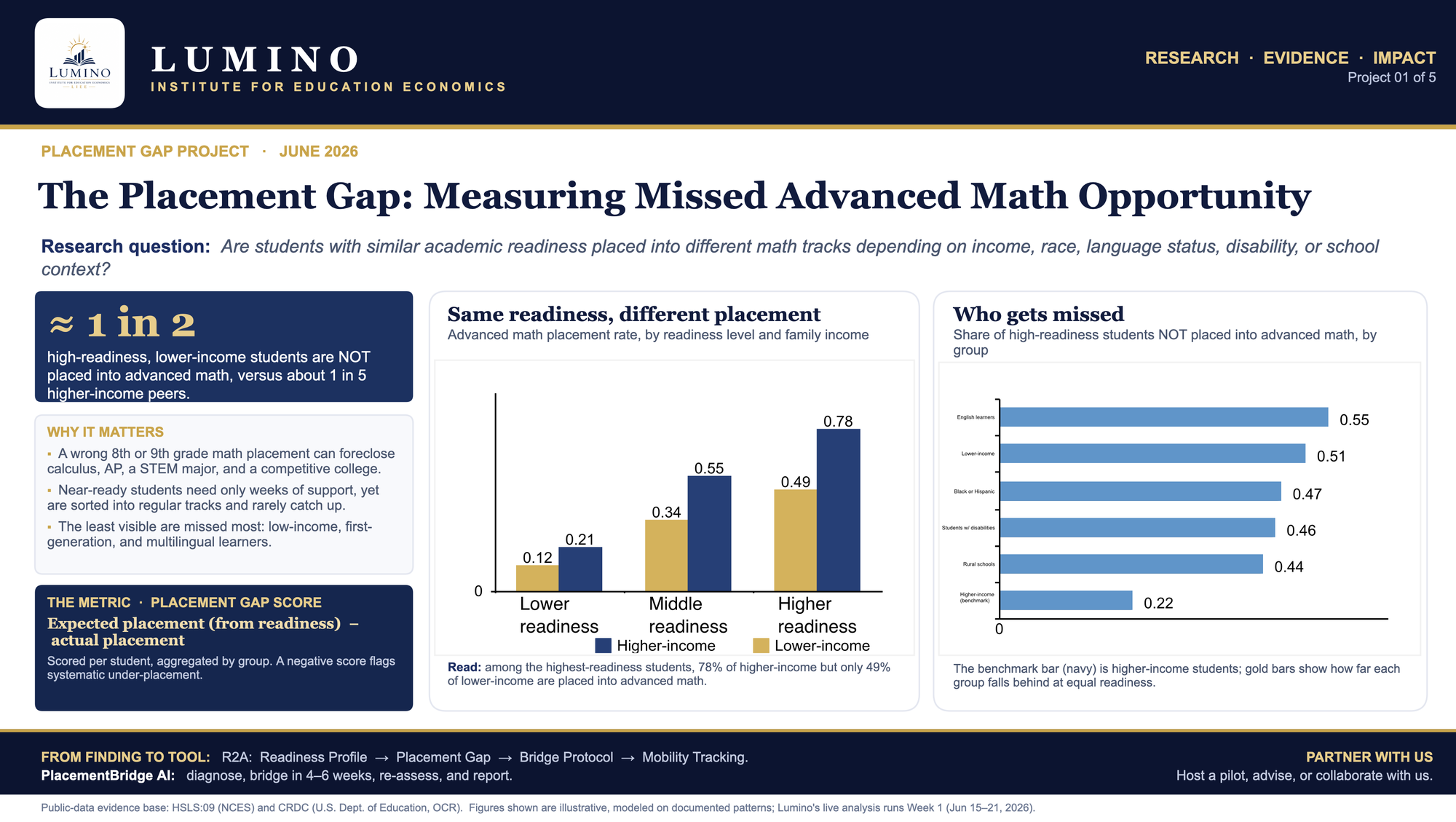
Measuring missed advanced-math opportunity using public education data: are students of similar readiness placed differently by income, race, language, or school context?

HSLS:09
02

Bridge Readiness

Identifying "near-ready" learners who could reach advanced placement through just 4–6 weeks of targeted bridge support.

Near-Ready Index
03

Advanced Opportunity Access Map

Mapping access to advanced coursework, gifted programs, and STEM pathways across U.S. schools: who gets access, and who does not.

CRDC
04

Financial Capability Readiness

Measuring what students know, feel, and do about money, and how it connects to background, confidence, and future mobility.

PISA
05

Learning-to-Mobility Measurement Framework

The connective tissue: a framework for measuring whether education produces opportunity and mobility, tracing Learning → Readiness → Placement → Opportunity Access → Financial Capability → Mobility.

Master framework

Featured work

From public data to a publication-ready brief.

Project 01 of 5 · The Placement Gap

Measuring Missed Advanced Math Opportunity

Our first framework report asks whether students with similar academic readiness are placed into different math tracks depending on income, race, language, disability, or school context, and proposes a single metric, the Placement Gap Score, to quantify it.

  • HSLS:09 · CRDC
  • Placement Gap Score
  • R2A framework
  • PlacementBridge AI

The team

A founding team building in the open.

MK
Mahdeen Sameer Khan
Research Lead

Research design, public-data analysis, and measurement frameworks.

Harvard Graduate School of Education
Connect on LinkedIn
DK
Damir Kozhanbayev
Research Lead

Education practice, school and nonprofit partnerships, and pilot and bridge design.

Harvard Graduate School of Education
Connect on LinkedIn

Our team and collaborators come from

Harvard University
Harvard Graduate
School of Education
Tufts University
Computer Science
UNICEF Kazakhstan

Who we are looking for

Building a small, focused founding team.

That means real ownership, fast learning, and the opportunity to shape both the research and the product from the start. You do not need to fit a role precisely. If your strengths overlap with this work, we would welcome a conversation.

Students collaborating in a library

Research & Measurement

Design studies, build the readiness and outcome instruments, analyze pilot data, co-author papers.

Statistics · study design · education or social science

AI & Software Engineering

Build the adaptive diagnostics and the PlacementBridge tool; instrument it to capture clean data.

Machine learning · full-stack · data pipelines

Learning Design

Design the diagnostics, bridge modules, and assessments that sit inside the tool.

Curriculum · pedagogy · assessment · learning science

Partnerships & Pilots

Build relationships with schools, colleges, and nonprofits; run pilots end to end.

Relationship building · program management · nonprofit experience

We especially welcome people who have seen these problems firsthand: educators, first-generation and multilingual learners, and anyone who has watched a capable student get sorted into the wrong place.

If this work resonates, we would welcome a conversation.

Whether you would like to join the team, collaborate on research, host a pilot, or advise, tell us a little about yourself and what drew you to the work.